Yes — if you are asking can Gemini make videos, Google Gemini generates 3-to-15-second video clips with native audio using its Gemini Omni model across Gemini Apps, Google Vids, and the Gemini API. What Gemini does not give you inside its standard chat window is a multi-track timeline to combine that generated shot with companion imagery, animated titles, camera keyframes, and music into a finished vertical video.
ChatCut is our product. This article uses a documented November 18, 2026 ChatCut Desktop project: a 7-second diner clip, a companion still, two animated titles, and music assembled into a 15-second vertical short. The saved run record identifies the host as Google Antigravity using Gemini 4 Carbon and records 3.80 ChatCut credits in generation charges. We checked the supplied video files and frame sheets for this article; the original host transcript and billing receipts were not included, so host attribution and charges below are attributed to that record. The prompt boxes are reusable instructions reconstructed from the recorded actions, not a verbatim chat transcript. The figures are supplied media frames, not screenshots of an Antigravity conversation.
The recorded generation costs were 3.43 credits for Gemini Omni 1.1 Flash, 0.15 credits for a GPT Image 2.6 Flare still, and 0.22 credits for instrumental music. The external agent authored the Remotion title graphics without ChatCut generation charges. These are this project’s recorded costs, not quotes for a new project:
If your goal is cutting raw camera footage you already recorded (removing retakes, filler words, and dead air from a talking-head video), read our companion test on can Gemini edit videos or the full Antigravity video editing walkthrough. Below, we cover how Google’s own Gemini video generators work as of November 18, 2026, reusable prompts and sampled frames from the documented 15-second build, where free quotas actually live, and when you need an editor beside the generator.
How do you make videos in Google’s Gemini apps (and what are the limits)?
Much of the confusion around Gemini video generation comes from Google shipping the same underlying model family across four different surfaces while retiring older Veo labels in consumer apps. As of November 18, 2026, here is what each official Google path actually produces:
| Google surface | Active video model (as of Nov 18, 2026) | Clip length per generation | Inputs accepted | Multi-track timeline? |
|---|---|---|---|---|
| Gemini Apps (gemini.google.com & mobile apps) | Gemini Omni 1.2 Flash per current Gemini Apps Help; the overview still names 1.1 Flash | 3 to 10 seconds standard; up to 15 seconds on Google AI Ultra; ~3-second looping GIFs in 8 countries | Text prompt, up to 5 photos, 1 uploaded video, or @username personal AI avatar | No — single-clip chat canvas with conversational redraw and up to +10s scene extension |
Google Vids (workspace.google.com / vids.new) | Gemini Omni 1.2 Flash | Up to 15 seconds per generated clip inside multi-scene Drive projects | Text prompts and reference images for generated clips | Browser video editor with scenes, animation, voiceovers, and music |
| YouTube Shorts & YouTube Create (Google DeepMind Omni launch) | Gemini Omni Flash | No per-clip limit specified in this launch source | See the available creation flow in your YouTube app | YouTube creation tools |
| Gemini API & Google AI Studio (ai.google.dev/gemini-api/docs/video) | gemini-omni-1.2-flash (gemini-omni-1.1-flash routes to 1.2 on Dec 3, 2026) | 3 to 15 seconds per call; extendable by 3 to 10 seconds per turn up to 30 seconds total | Text and up to 6 reference images; editing inputs up to 15s. Reference-video counts depend on output duration (API guide) | No — returns raw MP4 bytes or URI to your code |
Did Gemini Omni replace Google Veo?
Google describes Omni as the Veo replacement in Gemini Apps and now directs Gemini API developers to Omni. On Google’s Gemini Omni overview page, Google states directly that Gemini Omni replaces Veo 3.1 in the Gemini app, combining native audio generation, photo-to-video references, multi-turn conversational editing, and scene extensions in one multimodal model. For developers, Google’s Gemini API video documentation notes that standalone Veo 3.1 Preview endpoints (veo-3.1-generate-preview, veo-3.1-fast-generate-preview, and veo-3.1-lite-generate-preview) shut down on October 22, 2026, while pointing to GA Veo models on the Gemini Enterprise Agent Platform as another migration option. The Gemini overview still labels Omni as 1.1 Flash, whereas the current Apps Help and API guide name 1.2 Flash; the table follows each surface’s current help documentation.
Official steps inside Gemini Apps (and six boundaries to expect)
According to Google Help’s Generate videos with Gemini Apps guide (checked November 18, 2026), the desktop workflow on gemini.google.com is:
- Sign in to
gemini.google.comon an eligible 18+ account with a paid Google AI plan (or qualifying Workspace license). - Open the top-left sidebar and click Create video (or pick a style template).
- Enter your text prompt, optionally click Add image (up to 5 photos) or Add video (1 clip), or tag
@[your Google username]to use a recorded AI avatar. - Click Submit, wait a few minutes while the clip renders, then either send follow-up prompts to modify objects, camera angles, or add up to 10 seconds, or click Share → Download video.
Before you plan a whole campaign inside that chat box, keep six official constraints in mind as of November 18, 2026:
- 10-second ceiling on standard plans. Clips run 3 to 10 seconds unless you subscribe to Google AI Ultra, which unlocks 15-second generations (Gemini Apps Help). Even with scene extensions in the Gemini Omni API, a single chain tops out at 30 seconds total using a 10-second lookback window.
- Regional blocks on video uploads and avatars. Uploading your own video for edits and creating or sharing AI avatars are unavailable in the European Economic Area (EEA), Switzerland, the United Kingdom, and some US states (Gemini Apps Help). Looping 3-second GIF generation is limited to Australia, Canada, France, Germany, Japan, Korea, the UK, and the US, and is rolling out gradually.
- Locked chat during rendering. While a video or GIF is generating in Gemini Apps, you cannot interact with that same chat thread until rendering finishes.
- Ask explicitly for a continuous shot. Google’s Gemini Omni prompt guide warns that Omni Flash tries to cut between multiple shots to tell a mini-story unless your prompt explicitly asks for
"a single unbroken continuous shot"or"no scene cuts". - Voice editing and extension have different limits. Google describes Apps voice creation through avatars. The API does not support voice editing or adding dialogue by extending an uploaded talking video; it does support speech when extending previously generated videos through a multi-turn interaction (Omni API limitations).
- Imperceptible SynthID watermarking and no multi-track timeline. Every Omni output carries Google’s SynthID watermark, and downloading the MP4 still leaves you without separate tracks for animated typography, still-photo camera moves, transitions, or ducked background music.
How do you generate and cut a finished vertical video with Gemini in Antigravity and ChatCut?
To turn a single Gemini Omni clip into a publishable 15-second vertical piece without leaving a prompt workflow, the recorded workflow pairs Gemini in Google Antigravity with ChatCut Desktop (supported on macOS 13+ and Windows 10+ x64; Linux is not supported). When you connect your own coding agent — whether Antigravity, Codex, or Claude Code — reasoning uses the host agent’s own subscription or API allowance, subject to its plan limits, while ChatCut’s local timeline editing, Motion Graphics code, and watermark-free local exports cost 0 ChatCut credits. In this external-agent workflow, ChatCut credits pay for hosted media generation; cloud exports include a free allowance, and beyond it they follow ChatCut’s current credit rules (see Web vs Desktop Export). AI video and image generation require a paid plan. Antigravity’s model table currently lists Gemini 4 Carbon for Google AI Ultra and Enterprise, so do not assume every Antigravity account can use that model.
We set a hard budget of 5.00 ChatCut credits and designed a cohesive blue-hour Mojave roadside diner fashion teaser (“AFTER HOURS”) at 1080×1920 and 24 fps. The six steps below summarize the saved record, with reusable prompts, recorded quotes and charges, and supplied frame checks.
Step 1: Connect Google Antigravity to ChatCut Desktop
In a new macOS or Windows Antigravity conversation, send the one-line setup instruction from the ChatCut plugin page for Antigravity:
Antigravity installs the signed ChatCut Desktop app, connects its local editing tools, and links ChatCut’s editing and generation skills into your Antigravity config. Sign in to ChatCut, then start a new conversation in Antigravity so it loads the tools. The run record describes creating a new 1080×1920, 24 fps local project with no setup charge.
Step 2: Quote and generate the 7-second hero clip with Gemini Omni
ChatCut’s AI model catalog includes Gemini Omni (the run record identifies 1.1 Flash) alongside Seedance 2.5, Kling 4.0, MiniMax H3, and GPT Image 2.6 (see the Model Capability Matrix for exact per-model limits). Before spending anything, we had Gemini run read-only price quotes to compare upscaled 1080p against Omni’s native 720p output:
- 6 seconds at upscaled 1080p (9:16): quoted at 4.39 credits, leaving very little headroom under our 5-credit cap once image and music generation were added.
- 7 seconds at native 720p (9:16): quoted at 3.41 credits, giving us an extra second of camera movement at Omni’s native resolution (1080p and 4K on Gemini Omni are upsampled, per both Google’s API pricing docs and ChatCut’s matrix) while leaving 1.59 credits before the other assets, or 1.22 credits after the 0.15-credit still and 0.22-credit music estimates.
Following Google’s single-scene rule, we opened the prompt with "Single unbroken low-angle tracking shot" to request a continuous camera move. This is a prompting instruction, not a guarantee:
The run record lists a 3.41-credit estimate and 3.43-credit settlement. The available evidence does not establish a generation-only runtime or isolate the cause of the 0.02-credit difference. The supplied source file has a 7.0-second 720×1280 video stream (7.04-second MP4 container including audio):
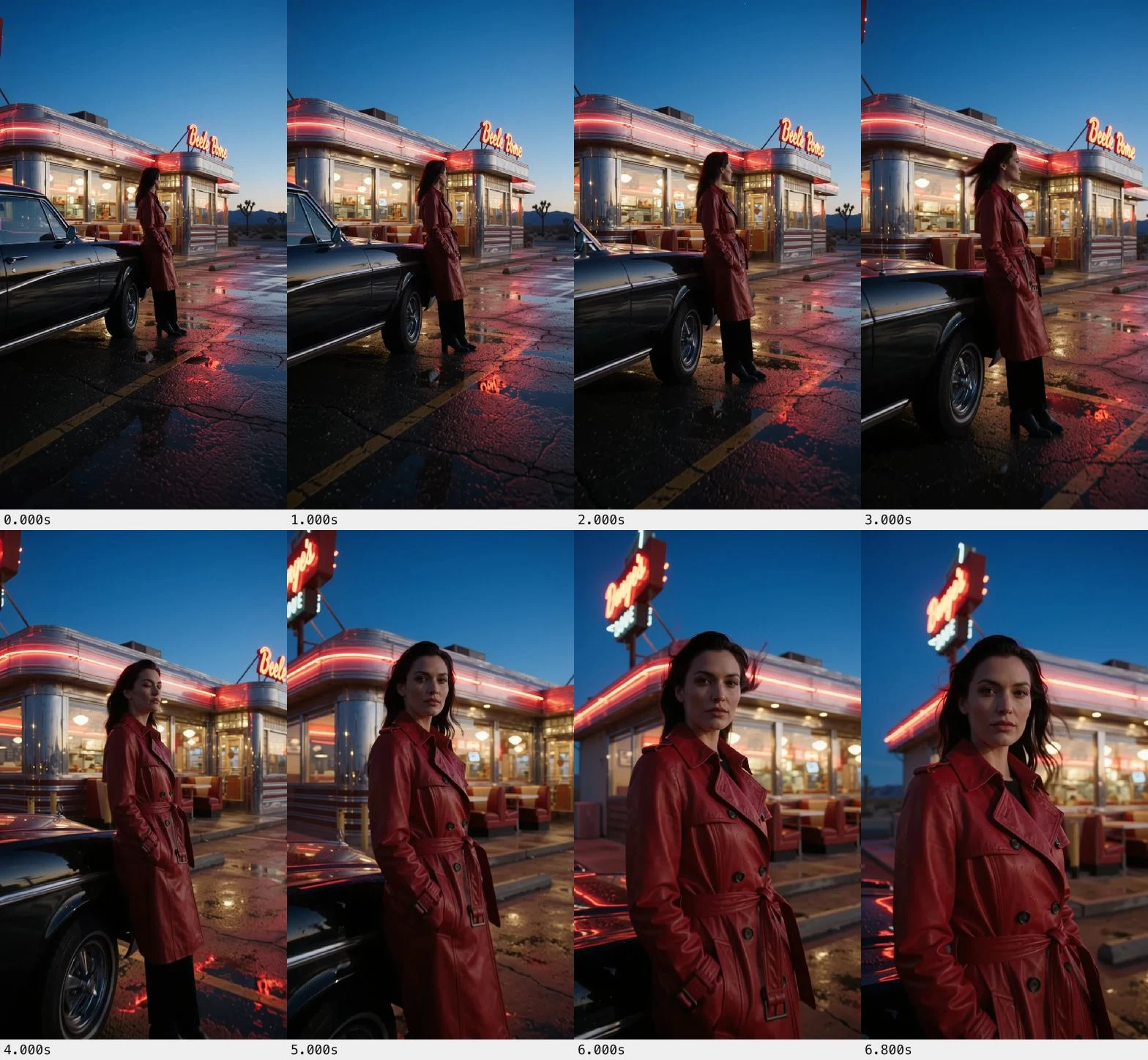
Gemini extracted eight sampled source frames from 0.000s to 6.800s to check motion continuity before placing the clip on the timeline:
Step 3: Pair it with a GPT Image 2.6 establishing frame and push-in camera motion
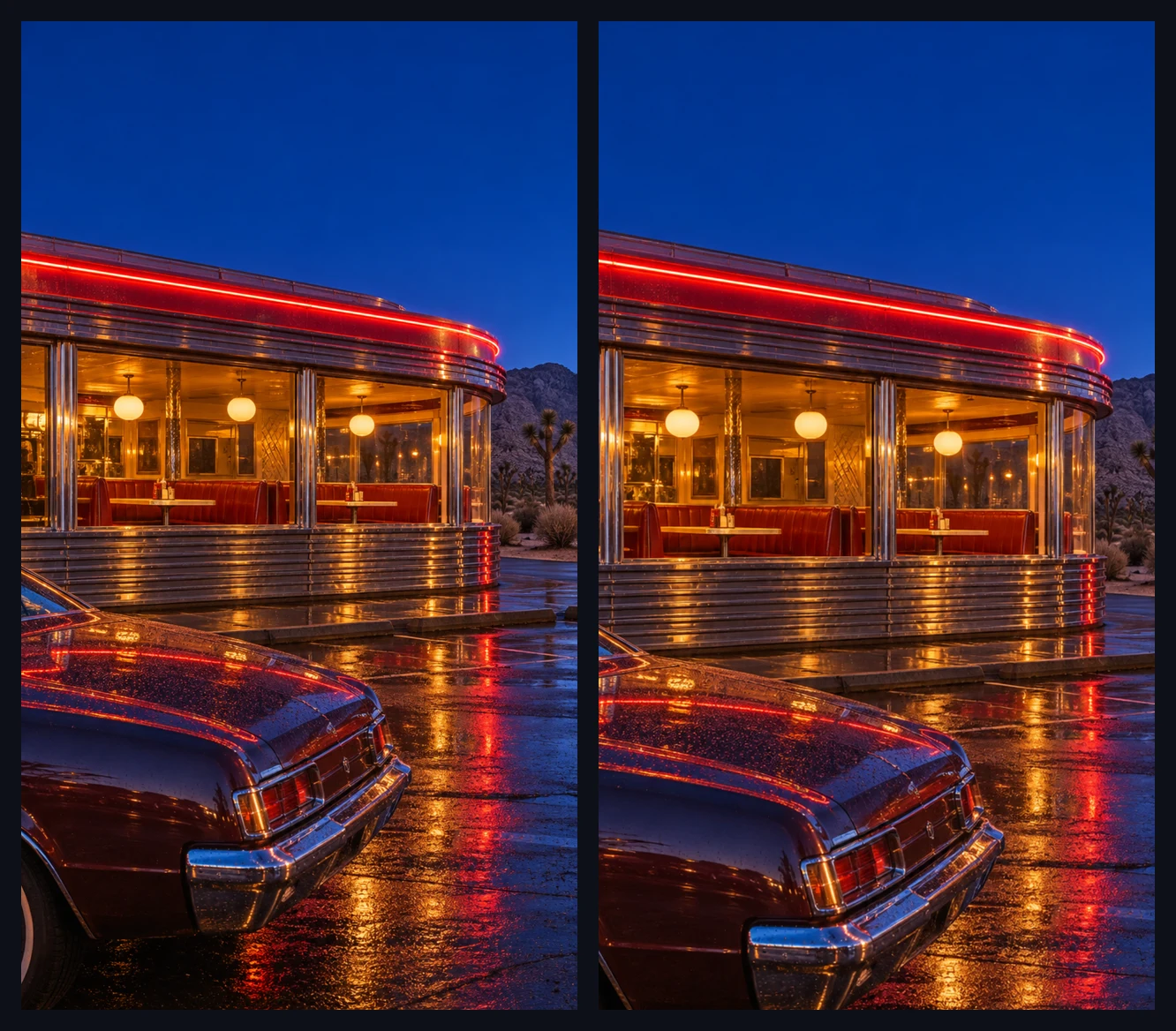
A single 7-second clip feels abrupt when a reel starts cold on the subject. Instead of spending another 3.4 credits on a second AI video shot, we generated a matching 9:16 architectural establishing photograph with GPT Image 2.6 Flare (1K, high quality) for 0.15 credits — requesting uncluttered sky for the opening title — and animated a smooth 1.00× to 1.14× ease-in-out push-in across the opening 5.7 seconds (136 frames at 24 fps):
Step 4: Author an editable title animation and closing end-card for 0 credits
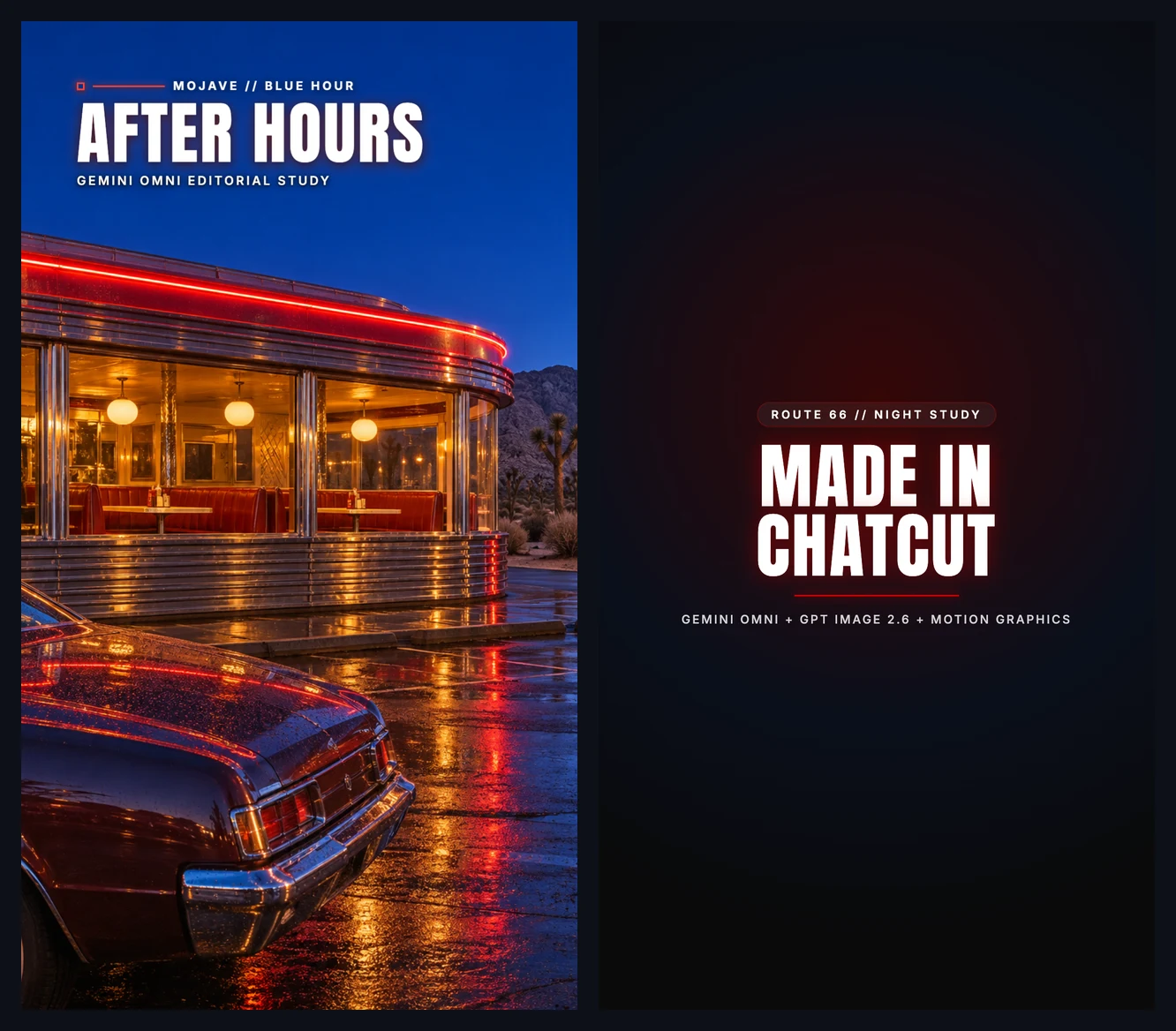
Next, Gemini browsed ChatCut’s Motion Graphics style catalog, pinned the Crimson Night Glass preset (Anton uppercase display type paired with Inter tracked labels), and wrote two frame-rate-independent Remotion graphics directly into the project workspace:
- Opening Title Overlay (
V2, 0.25s to 5.00s): Typography on a transparent background (MOJAVE // BLUE HOUReyebrow,AFTER HOURSheadline, andGEMINI OMNI EDITORIAL STUDYsubtitle) positioned in the upper sky with no rectangular card box blocking the photography. - Closing End-Card (
V1, 12.33s to 15.00s): A full-frame 1080×1920 dark crimson-glow card (ROUTE 66 // NIGHT STUDY/MADE IN CHATCUT) bringing the short to an exact 360-frame (15.0-second) finish.
Step 5: Inspect composed frames and fix a low-contrast title detail
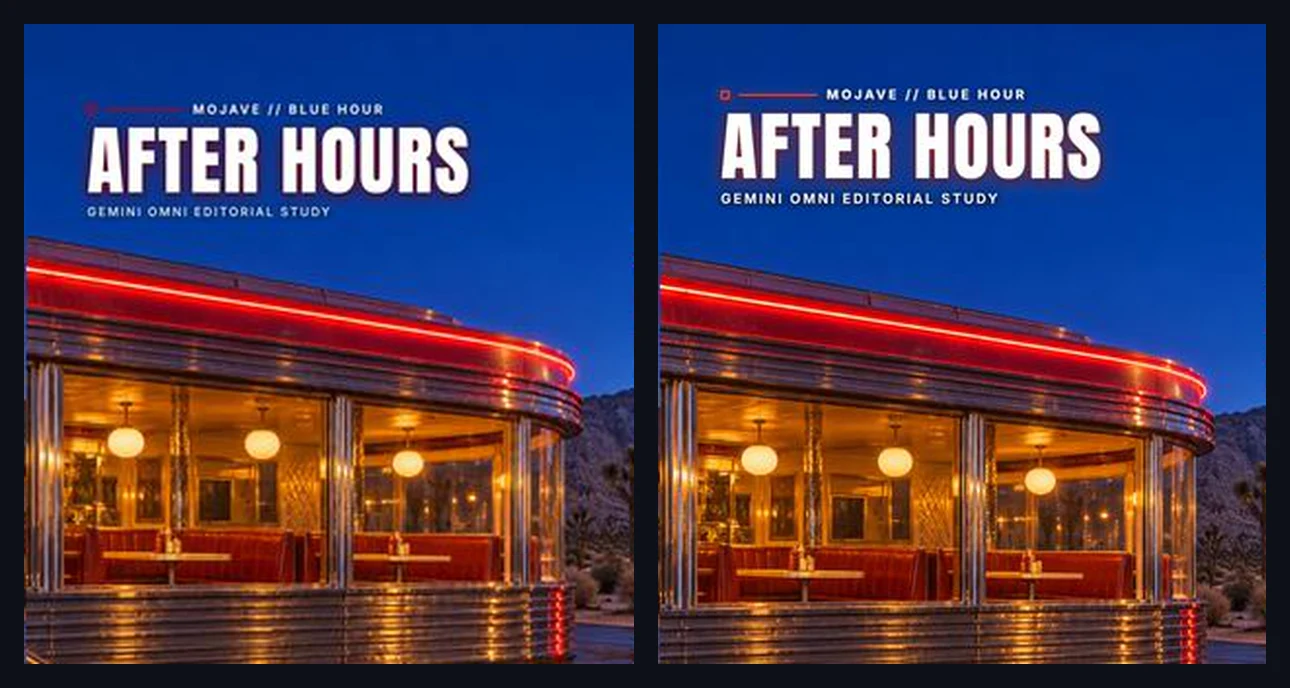
Tool calls succeeding in code do not guarantee legibility over real photography. When Gemini rendered a 14-frame preview contact sheet of the composed timeline, we spotted two subtle visual flaws right away:
- Over the saturated #093282 blue-hour sky, the preset’s dark #CC0000 geometric square and horizontal rule nearly vanished, and as the camera pushed in by 5.3s, the glowing red diner roofline drifted slightly too close to the 21px subtitle.
- The record says a 10-frame fade-in initially left Frame 0 black. We removed that edit so the finished file opens immediately on the diner.
Because the graphic lived as editable code and properties on V2 rather than pixels burned into an AI video, the record describes revising the graphic and opening image with 0.00 ChatCut credits in additional generation charges. This reusable prompt summarizes the changes:
Step 6: Bridge the cut, mix custom synth music, and export the 15-second MP4
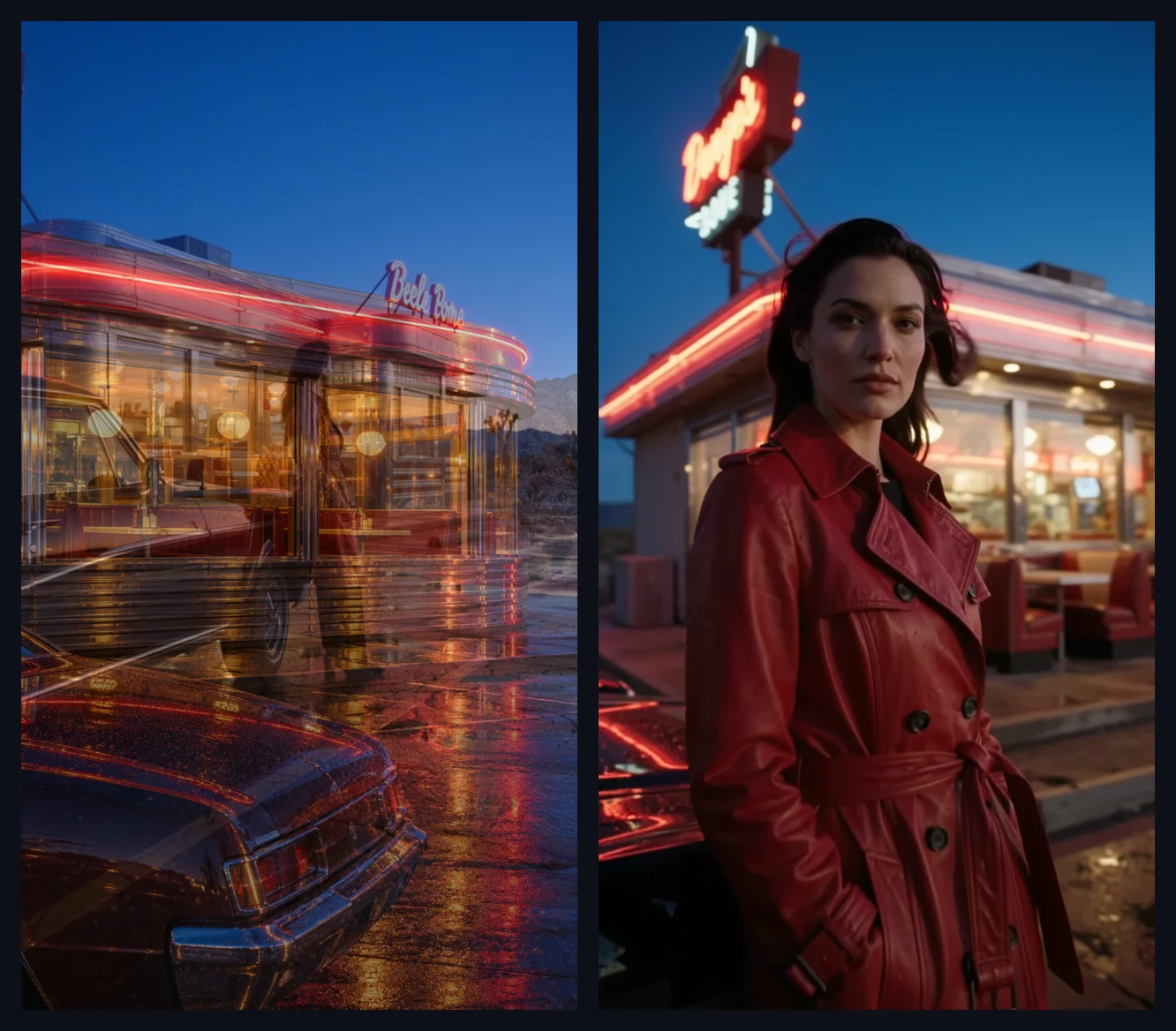
To connect the GPT Image 2.6 diner still to the Gemini Omni tracking shot without a jarring jump, Gemini trimmed 0.25s (6 frames) of head handle onto the incoming Omni video, placed a centered 12-frame (0.50s) Cross Dissolve so the horizontal red neon rooflines melted directly into each other, requested a custom nocturnal synthwave backing track at 92 BPM (0.22 credits), and tucked Gemini Omni’s native desert wind and neon room tone underneath at -14 dB:
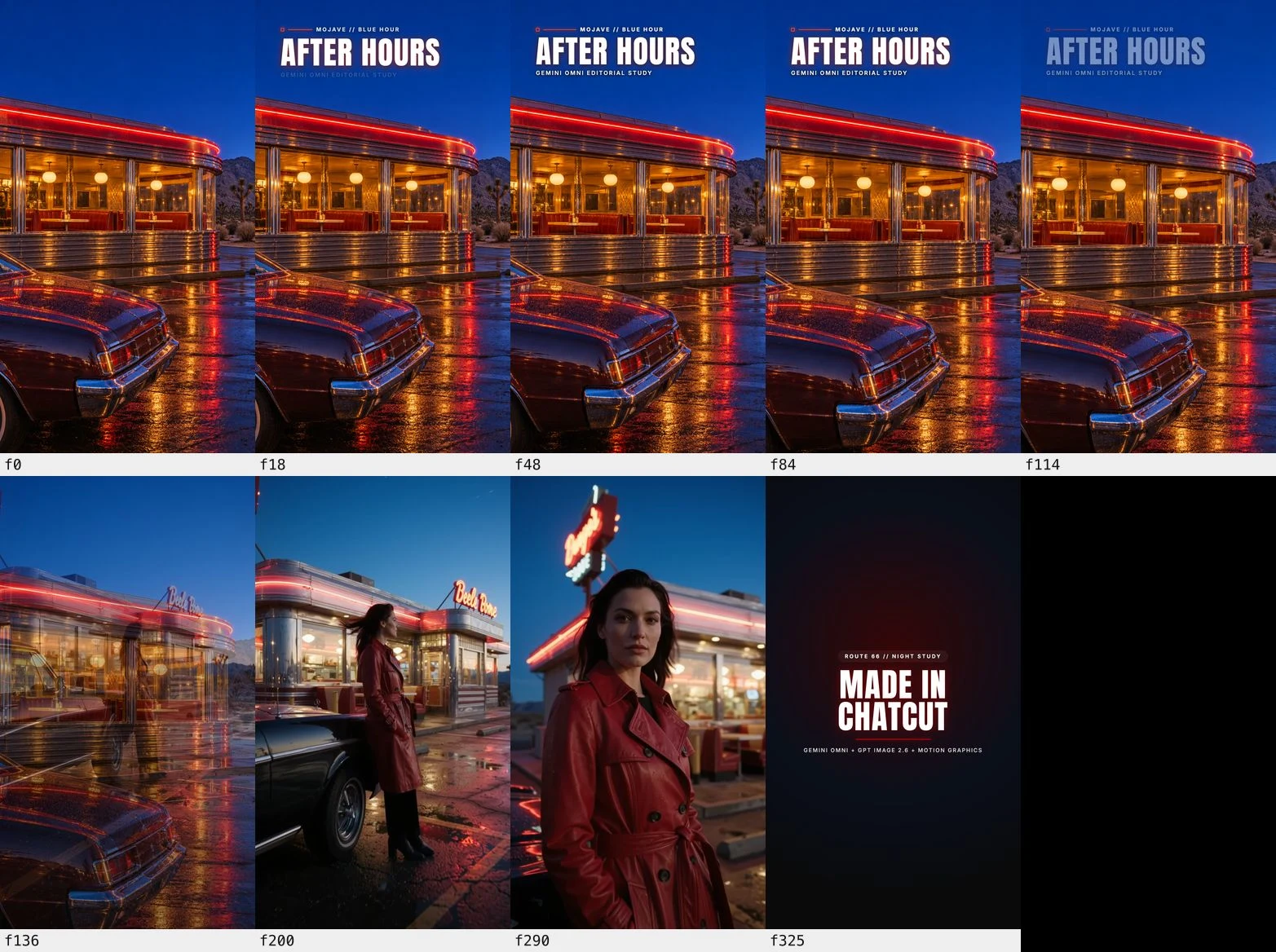
Our check of the supplied final MP4 measured −19.7 LUFS integrated loudness and approximately −4.8 dBTP true peak. The supplied contact sheet samples nine frames from Frame 0 through Frame 325; it is not a frame-by-frame review of all 360 frames:
The recorded workflow used the editor’s local tools for project setup, price estimates, generation, graphic creation, timeline edits, previews, and export. These steps share the same external-agent connection; the host’s reasoning allowance is separate from the media-generation charges.
Can Gemini make videos for free? Plans and limits as of November 18, 2026
As of November 18, 2026, the answer depends on which Google door you walk through: standard gemini.google.com personal chats require a paid Google AI subscription for video generation, whereas Google Vids (vids.new) and YouTube Shorts / YouTube Create offer no-cost Gemini Omni access. The three-video monthly allowance below applies specifically to Vids; the cited YouTube announcement does not give a monthly cap.
| Surface | Free video generation? (as of Nov 18, 2026) | Paid tiers & official allowances (as of Nov 18, 2026) | Source |
|---|---|---|---|
Gemini Apps (gemini.google.com & mobile) | No on standard personal accounts (student promotions vary by eligibility) | Requires Google AI Plus, Google AI Pro, or Google AI Ultra (or qualifying Workspace license). Compute-based limits refresh every 5 hours up to a weekly cap; AI Plus gives 2× standard limits, AI Pro 4× standard limits, and AI Ultra 5× or 20× AI Pro limits depending on subscription. These are overall usage limits, not guaranteed video counts; Ultra also enables 15-second clips | Generate videos Help, Gemini Apps limits |
Google Vids (vids.new) | Yes — up to three 15-second Omni 1.2 Flash videos per month at no cost with any personal Google Account or Workspace login (announced Nov 5, 2026) | Workspace Business Starter: 200s/mo video + 10 avatars/mo; Business Standard/Plus and Enterprise Standard/Plus: 500s/mo + 25 avatars/mo; AI Expanded Access: 2,000s/mo + 100 avatars/mo (resets monthly) | Google Workspace Blog (Nov 5, 2026), Workspace AI Expanded Access |
| YouTube Shorts & YouTube Create | Yes — Gemini Omni Flash rolled out at no cost inside Shorts and the YouTube Create app | Subject to YouTube app feature rollout and regional availability | Introducing Gemini Omni |
| Gemini API / Google AI Studio | No — Free Tier is listed as Not available for Gemini Omni 1.2 and 1.1 Flash | Paid Tier token billing on gemini-omni-1.2-flash: $1.50 / 1M input tokens and $12.00 / 1M video output tokens (~$0.07/sec at 720p, $0.023/sec at 360p, $0.104/sec at upscaled 1080p, $0.209/sec at upscaled 4K; 1.1-flash is ~$0.10/sec at 720p until Dec 3, 2026) | Gemini API Pricing |
| Google Antigravity + ChatCut Desktop | 0 ChatCut credits for external-agent timeline cuts, transcription, captions, coded Motion Graphics, and watermark-free local MP4 or standard XML export on ChatCut Free | AI video and image generation require a paid plan and credits; plans start at $25/month for 100 credits or $252/year. Transparent rendered graphics bundled with XML require Pro. The run record lists 3.80 credits for this 15s project (3.43 Omni 7s 720p + 0.15 GPT Image 2.6 Flare + 0.22 custom music; 0.00 for editing, titles, and local export) | Saved project run record dated Nov 18, 2026; original receipts were not supplied |
Two ways to plan a similar generation budget:
- Do not pay video-generation prices for static establishing shots or typography. Replacing a second 7-second Omni clip (~3.43 credits) with a 0.15-credit GPT Image 2.6 Flare architectural photograph plus keyframed camera push-in would reduce that two-video comparison from about 6.86 to 3.58 credits (about 48%) at the recorded prices while giving our opening title cleaner framing.
- Always check native vs. upscaled resolution before paying extra. Because Gemini Omni generates natively at 720p and upsamples 1080p and 4K, generating our 7-second shot at 720p (3.43 credits) and letting ChatCut Desktop composite crisp 1080×1920 vector Motion Graphics over the sequence kept every letter tack-sharp on export without burning our 5-credit budget.
When should you use Gemini on its own, and when do you need a video editor?
Use the simplest tool that matches your deliverable:
- Stay inside Gemini Apps (
gemini.google.com) or Google Vids (vids.new) when you just need one standalone 3-to-15-second concept clip, a quick looping GIF reaction, a conversational wardrobe/lighting remix of a short clip (outside restricted regions), or a presentation-style Workspace update using your three free monthly Vids generations. - Pair Gemini in Google Antigravity with ChatCut’s AI video editor when that generated clip is only one ingredient in a real video — when you need to combine AI video generation from multiple models (Gemini Omni, Seedance 2.5, Kling 4.0) with keyframed stills, editable Motion Graphics with text you can proofread, multi-track audio mixing, or an FCP7 XML handoff to Premiere Pro or DaVinci Resolve.
Three copyable prompts you can adapt today
1. Single unbroken cinematic shot (works in Gemini Apps, Google Vids, or ChatCut):
2. Conversational style or object edit on a short Gemini Omni clip (follows Google’s brevity rule):
3. Complete 15-second vertical reel in Antigravity + ChatCut under 5 credits:
What you still need to check yourself
Even after an agent inspects contact sheets and audio loudness, always review four things by eye and ear before publishing:
- Background signage and incidental lettering inside generated video. Our prompt did not specify diner-sign text, and the supplied frames show pseudo-cursive neon on the rooftop (
"Beele...") in the wide frames (0.0s–3.0s). If a storefront or prop sign will be visible, either spell out its exact text in quotes in your prompt (as Google’s Omni text guide recommends) or keep all critical headlines on a separate ChatCut Motion Graphics track where you can set and proofread the exact text. - Native 720p detail on large monitors. Omni’s 720p footage holds up well on phone screens and social feeds, especially beside crisp 1080×1920 typography, but inspect fine facial or fabric detail at full screen before delivering client work.
- Dissolve alignment and audio tails. Step through the midpoint of any dissolve (
Frame 136in our project) to verify horizon lines don’t clash, and play the exported.mp4outside the editor to confirm the music fade-out ends cleanly on the final frame. - Synthetic media disclosure. All Gemini Omni outputs include Google’s invisible SynthID watermark, and platforms such as YouTube require creators to check the altered or synthetic content disclosure box when realistic AI-generated people or scenes could be mistaken for real events.
Troubleshooting common snags
- ChatCut tools don’t show up in Antigravity. Antigravity loads MCP servers only when a conversation starts. Confirm you signed in inside ChatCut Desktop, check Customizations → Installed → MCP Servers in the Antigravity App to verify the ChatCut connection is enabled, and open a new conversation (official MCP guide).
- Gemini Apps refuses to upload your video or create an avatar. If your Google account is in the EEA, Switzerland, the UK, or a restricted US state, Google blocks video-edit uploads and avatars in Gemini Apps as of November 18, 2026 (Gemini Apps Help). Text-to-video and photo-to-video still follow your local plan eligibility, and local timeline editing in ChatCut Desktop runs directly on your Mac or Windows PC.
- Final credit settlement differs slightly from the pre-run quote. Estimates and completed deductions can differ: the run record lists 3.41 quoted and 3.43 settled credits for the video. Check the completed charge in Credits history; this record does not isolate the reason for the difference. Leave a 0.5 to 1.0 credit cushion when working against a hard project ceiling, or swap secondary video cutaways for 0.15-credit GPT Image 2.6 Flare stills with keyframed camera motion.